
Behavioral Language Acquisition Model (BLAM®)
Clinical Overview
What is the Behavioral Language Acquisition Model?
Our Behavioral Language Acquisition Model (BLAM) is a form of discrete-trial therapy that is based on the precise principles and procedures of behavior analysis (ABA) and our current knowledge of child development. The model was developed by Lubin and Alexander in 1997 and continues to evolve as new principles are identified. The primary goal of BLAM is to address developmental skill deficits in the individual child and implement procedures in order to accelerate the child’s skills so that they may more closely resemble the skills of their age-related peers.
BLAM Procedures
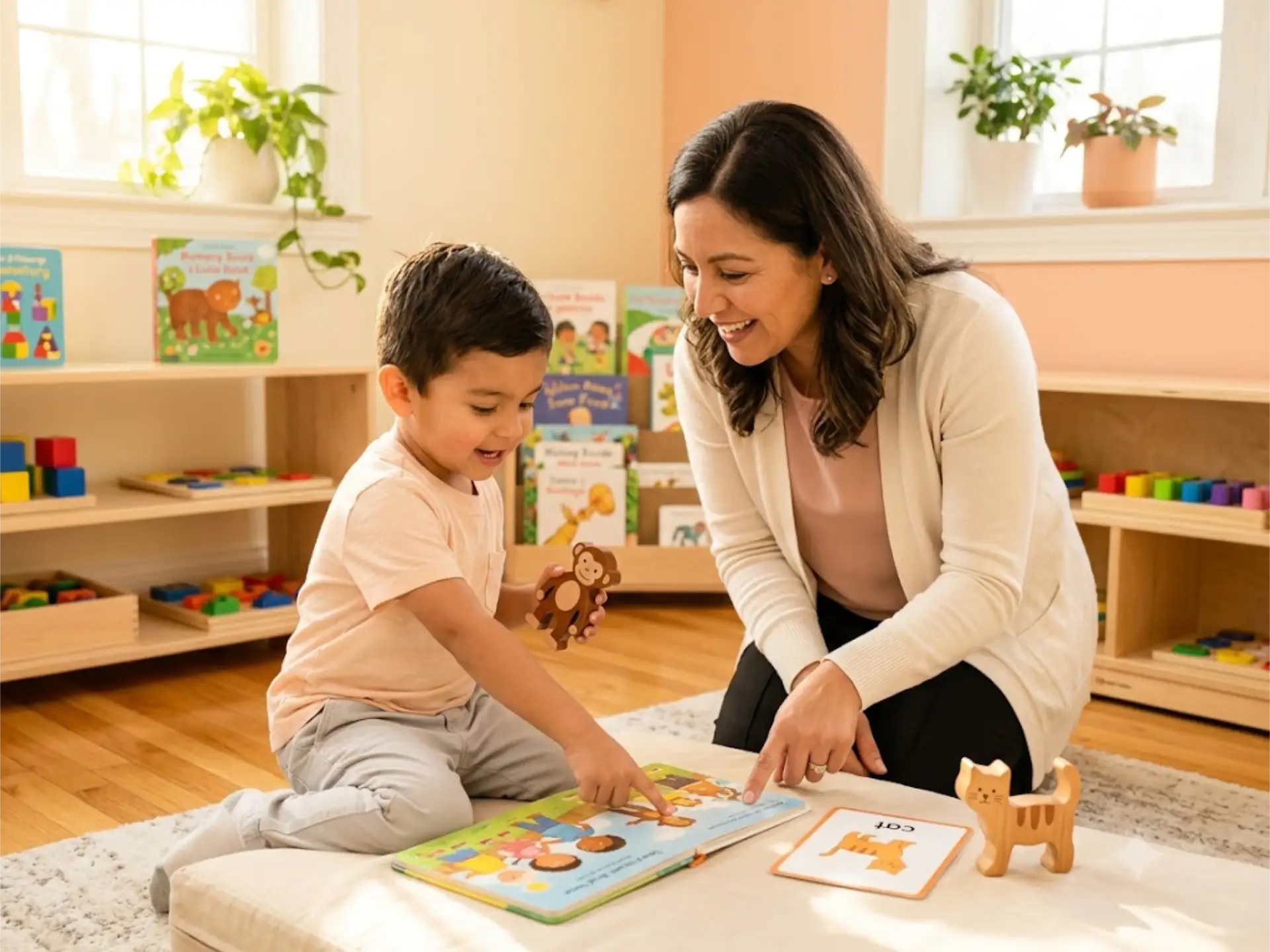
BLAM utilizes a discrete-trial methodology. Discrete-trial therapy is a specific method of intensive teaching that involves one-on-one therapy between a therapist and a child. While discrete-trial instruction is a very effective method of teaching for all children regardless of disability, it is one of the most effective methods of instruction that have been demonstrated to be effective in aiding children with developmental deficits.
BLAM is similar to other discrete-trial methods in terms of the procedures utilized.
- Discrete-Trial: Describes a specific instance of learning which includes: presentation of the antecedent cue (SD) or instruction; child’s response; presentation/removal of a consequence (SC)
- Reinforcement: Consequences (i.e., preferred foods, favorite toys, social praise, affection) are delivered following a correct response by the child to increase specific responses that are targeted as indicated by your child’s individualized program.
- Prompts: A procedure used to aid the child in successfully acquiring the targeted skills.
- Repetition: Trials on a specific skill are repeated
BLAM differs from other ABA models in that it is a rate-based model. BLAM is driven by the principle of contingency-contact density, or rapid repetition of trials during a given unit of time during skill acquisition. Evidence suggests that the more frequently a child comes into contact with a particular event, the more quickly the child will learn. In addition, high-density trials result in brief inter-trial intervals (i.e., time between successive trials). This is advantageous because it offers fewer opportunities for the child to engage in behavior that may compete with learning. As skills are acquired, they continue to be used throughout the child’s day so that they are maintained in the child’s repertoire. In addition, acquired skills are intermixed with developing skills across trials to ensure adequate reinforcement density and to minimize frustration. Previous research suggests that 40 hours per week is necessary to attain maximum results. However, because BLAM is a rate-based model, we have been able to achieve significant results with children receiving 10 hours of therapy per week.
BLAM Curriculum
The curriculum of any model defines the specific program goals and when these goals are introduced. BLAM addresses deficits from all developmental domains, including: speech/language/communication; social/play; daily living/independent functioning; cognitive/academics; and motor. BLAM is based on a pure behavioral language model (Skinner, 1957) and is influenced by typical developmental in multiple developmental domains. BLAM differs from other verbal behavior models in that it involves concurrent development of echoics, tacts, and mands.
In the initial stages of BLAM, the objectives are focused on developing learning readiness, imitation, intensive vocabulary building, and the development of speech:
- Instructional control: This domain is essential in developing specific skills necessary for effective learning. The skills include: remaining seated; establishing and maintaining eye-contact; and compliance with instructions.
- Imitation (echoics): The focus of this domain is to develop imitative skills that are utilized to shape specific motor and vocal behavior. The development of echoics are used to progress from motor to vocal responding.
- Requesting (mands): Our focus in this domain is the development of skills that will enable the child to appropriately request desired items/activities and information about items/events. The development of mands are used to teach the child that vocal responses have communicative functions.
- Labeling (tacts): This domain is designed to build your child’s vocabulary in all linguistic domains (e.g., nouns, verbs, adjectives, prepositions, pronouns, etc.). Tact development progresses from motor to vocal responding.
In the advanced stages of BLAM, the objectives include:
- Expanding Grammar and Syntax: Single-word tacts are combined so that the child will communicate using increasingly complex descriptions of items/events. Goals will continue to focus on increasing the mean length of utterance (MLU) and number of conversational exchanges.
- Generalization: The objective is to encourage the child to exhibit acquired skills in more naturalized environments.
- Pragmatic Use of Language: This domain entails the use of mands and tacts in more naturalized situations so that communication more closely resembles typical social interaction. In addition, the focus is on teaching the child appropriate skills in navigating social interactions with peers.
- Specific academic concepts (textuals, transcription, mathematics, etc.): This domain involves training in the three R’s – reading, writing, and arithmetic. These are necessary skills for successful adaptation to a typical educational environment.
- Independent Functioning Skills: This domain focuses on the child’s ability to independently engage in daily living skills, such as: dressing; grooming; toileting and social behaviors necessary for inclusion in more normalized educational/community settings.

Supervision and Monitoring of BLAM
Establishing and Maintaining the Goals of Your Child’s Individualized Program – The Key to Successful Intervention.
The goal of BLAM is to accelerate your child’s development in order to “bridge” the differences between your child’s development and typical children of the same age group. During the intake, our supervisory staff identified concerns regarding specific skill deficits and behavioral atypicalities. A standardized assessment will be conducted prior to the child’s first week of therapy to assess your child’s current level of functioning and set the initial discrete-trial program goals to address their specific developmental skill deficits. Just as the program goals are individualized and tailored to your child’s specific skill deficits, each child’s rate of learning will vary. Therefore, once work begins, the program goals are continuously modified. This is done to ensure that we are achieving optimal results with your child.
Tracking Your Child’s Progress
To assure that your child is achieving optimal progress, intensive supervision and monitoring by our supervisory clinical staff is required on a weekly basis. During the supervision and monitoring process, we examine the child’s current level of functioning in comparison with the program goals established during the intake or previous supervision. The supervision and monitoring process involves the following:
- Scheduled direct examination of your child’s progress and the teaching strategies employed.
- Impromptu direct examination of your child’s progress and the teaching strategies employed.
- Indirect examination of your child’s progress with the current short-term goals.
On a semi-annual basis, a standardized assessment will be implemented to document changes in developmental functioning. This is done to ensure that the gap between the child’s current level of functioning and expected level of functioning is narrowing. In addition, such an assessment may identify additional deficits as the
child ages.
What happens during the supervision/monitoring process?
During the scheduled direct examination, a clinician will directly observe your child’s therapy session and review the data. At this time a monitoring form documenting any changes will be completed and placed in your child’s program book. Any of the following may occur during the monitoring:
- If a goal has been mastered, we will advance your child’s goal to the next step as outlined in BLAM.
- If a child is not progressing on a specific goal, it may be necessary to change to an alternate or simpler goal.
- It may be necessary to make slight modifications in the procedures that the therapist is using to achieve the specific program goals established for your child.
Impromptu analyses of your child’s program goals occur when:
- Our clinical supervisors notice that your child may be having problems or may be close to mastering a critical goal during unscheduled observations.
- At such time, adjustments in the goals or teaching strategies may be implemented.
- These observations typically take 5 to 15 minutes.
- These short observations are critical and can only be offered if the child’s therapy is being conducted in our office.
Indirect examination of your child’s progress with the current short-term goals involve:
- Direct meetings with your child’s therapist regarding specific program goals/procedures.
- Examination of the data in your child’s program book, which is indicative of your child’s progress, before or after training sessions.
- Documenting changes to the program in your child’s program book or on a monitoring sheet during non-session times.
Following a monitoring/supervision, our supervisory clinical staff will review your child’s progress with you and explain any modifications made during the course of the supervision process. The monitoring activities are a subset of the overall supervision and although most are conducted weekly, they may sometimes be conducted multiple times in a week or every other week depending on your child’s progress and other logistical issues. In addition, most monitoring activities are conducted during the training session so that the clinical supervisor can test certain adjustments or make direct observations if needed.
This is not an optional service, supervision/monitoring are a mandatory aspect of the BLAM model to ensure optimal progress of your child. Overall, no singular supervisory activity alone is sufficient for optimizing your child’s progress during discrete-trial interventions. Instead, success depends on the combination of these activities that are provided in accordance with your child’s performance, attendance during a given week and a number of other logistical variables that often occur. As we consider our collective and personal missions to rehabilitate and recover our children in the most timely manner, we can assure you that decisions concerning the correct supervisory activities will be carried out diligently on a day-to-day basis.
Related FAQs
How are BLAM services delivered?
An intake is conducted by a senior member of our staff to identify your child’s current level of functioning and to identify specific skill deficits and behavioral atypicalities. Your child’s individualized program will be developed to address these specific developmental skill deficits.
In discrete trial therapy, a child works individually with the therapist. Our approach entails repeated drilling of specific skills identified as deficient until the child has demonstrated mastery of these specific skills. Typically, discrete trial therapy is provided 2 hours per day each day for a minimum of 10 hours per week. Previous research suggests that 40 hours per week is necessary to attain maximum results. However, we have been able to achieve significant results with children receiving 10 hours of therapy per week. Our patients who have participated in less than the 10 hours recommended have demonstrated much slower progress or occasionally regression in the progress of specific goals. Therefore, it is highly recommended that you entrust us with your child for the recommended 10 hours per week.
A maximum of two therapists will be assigned to work with your child. We do this to ensure that more than one therapist is familiar with your child and his individual program in the case of a therapist’s illness or other emergency. In addition, it is facilitative for your child because he/she will learn to respond to instructions given by more than one person.
Who delivers BLAM services?
Our clinical team consists of two primary roles:
- BCBA (Board Certified Behavior Analyst): Holds a Master’s or Doctoral degree, has completed extensive supervised fieldwork, and has passed a national certification exam. They design and oversee the program.
- RBT (Registered Behavior Technician): Has completed a minimum of 40 hours of specialized training, passed a competency assessment, and passed a credentialing exam. They provide direct, day-to-day therapy.
What to expect during the therapy session?
It is not uncommon for children introduced into an intensive instructional program to exhibit some “unusual” behaviors. While these behaviors may be odd or uncommon to you as the parent, they are very typical of children initially introduced to a highly intensive instructional program.
You can expect to see the following behaviors from your child during the first two weeks of therapy and following any significant changes in your child’s program:
- Crying/Tantrums
- Vomiting
- Urination or Bowel Movements
- Aggression
- Passive Non-Compliance (closing eyes and/or not attending to the therapist)
Our therapists are trained to deal with these types of behavior. Often, children exhibit these forms of behavior to terminate or to delay an unpleasant activity that is difficult for them or that they don’t wish to engage in. While we understand that it may be difficult for you to see your child reacting in this way, our therapists are trained to deal with these types of behavior.
What can I do to facilitate my child’s progress during the therapy session?
In order to assist us in maximizing your child’s progress we recommend that you follow these general guidelines:
- Please bring your child’s favorite items that will help us motivate your child to learn (e.g., toys, food, videos, books, etc.).
- Minimize your child’s access to these favorite items prior to therapy to ensure that your child does not tire of these items.
- If your child’s favorite items include food, do not feed him a considerable amount of food prior to therapy.
- Bring photographs of favorite items and people/places within and around your home. It is often easier to teach children specific concepts when we are working with photographs of people and items relevant to the child.
- Avoid entering the therapy room during your child’s session. Often this indicates to the child that the therapy session has ended and will trigger emotional reactions in the child when you leave the room and the therapy session resumes.
What can I do to facilitate my child’s progress outside of the therapy session?
Pay attention to the goals your child is working on. Use the instructions that the therapist uses during therapy sessions in the home environment. For example, if the therapist is asking your child to point to something he/she wants, ensure that he points to requested items before you provide him/her with the item.
What forms of payment do you accept?
We accept all major credit cards for ABA, Autism Assessments, BLAM and Parent Training.
How do we get started?
- Intake: Submit an inquiry along with a diagnostic report (if applicable) and insurance information.
- Authorization: We request approval from your insurance provider for the initial assessment.
- Assessment: The BCBA conducts the evaluation and writes the treatment plan.
- Therapy Begins: Once insurance approves the treatment plan hours, your scheduling and direct sessions begin.
Can services be provided in languages other than English?
Yes. We believe that therapy is most effective when communication is natural and comfortable for the individual and their family. We strive to match families with bilingual or multilingual BCBAs and RBTs whenever possible to support primary home languages.
What is the Behavioral Language Acquisition Model (BLAM)?
Our Behavioral Language Acquisition Model (BLAM) is a form of discrete-trial therapy that is based on the precise principles and procedures of behavior analysis (ABA) and our current knowledge of child development. The model was developed by Lubin and Alexander in 1997 and continues to evolve as new principles are identified. The primary goal of BLAM is to address developmental skill deficits in the individual child and implement procedures in order to accelerate the child’s skills so that they may more closely resemble the skills of their age-related peers.